China's Space Program: Where Technology Meets Poetry
- China builds rockets, space stations, lunar landers, and planetary probes using some of the world's most advanced technology.
- Yet their names come from ancient goddesses, legendary bridges, classical poetry, and questions asked thousands of years ago.
- The further China reaches into space, the more poetic its spacecraft names seem to become.
Contents
A space program written in poetry
Space exploration is among humanity's most advanced technological achievements.
It demands extraordinary precision, powerful computers, sophisticated engineering, and years of scientific research.
Yet look at the names of China's spacecraft.
You will find almost no cold technical language.
Instead, you encounter goddesses, lovers, celestial palaces, ancient poets, and the mystery of creation itself.
It is as though China's space program were turning thousands of years of literature into a map of the universe.
A goddess, a rabbit, and a bridge
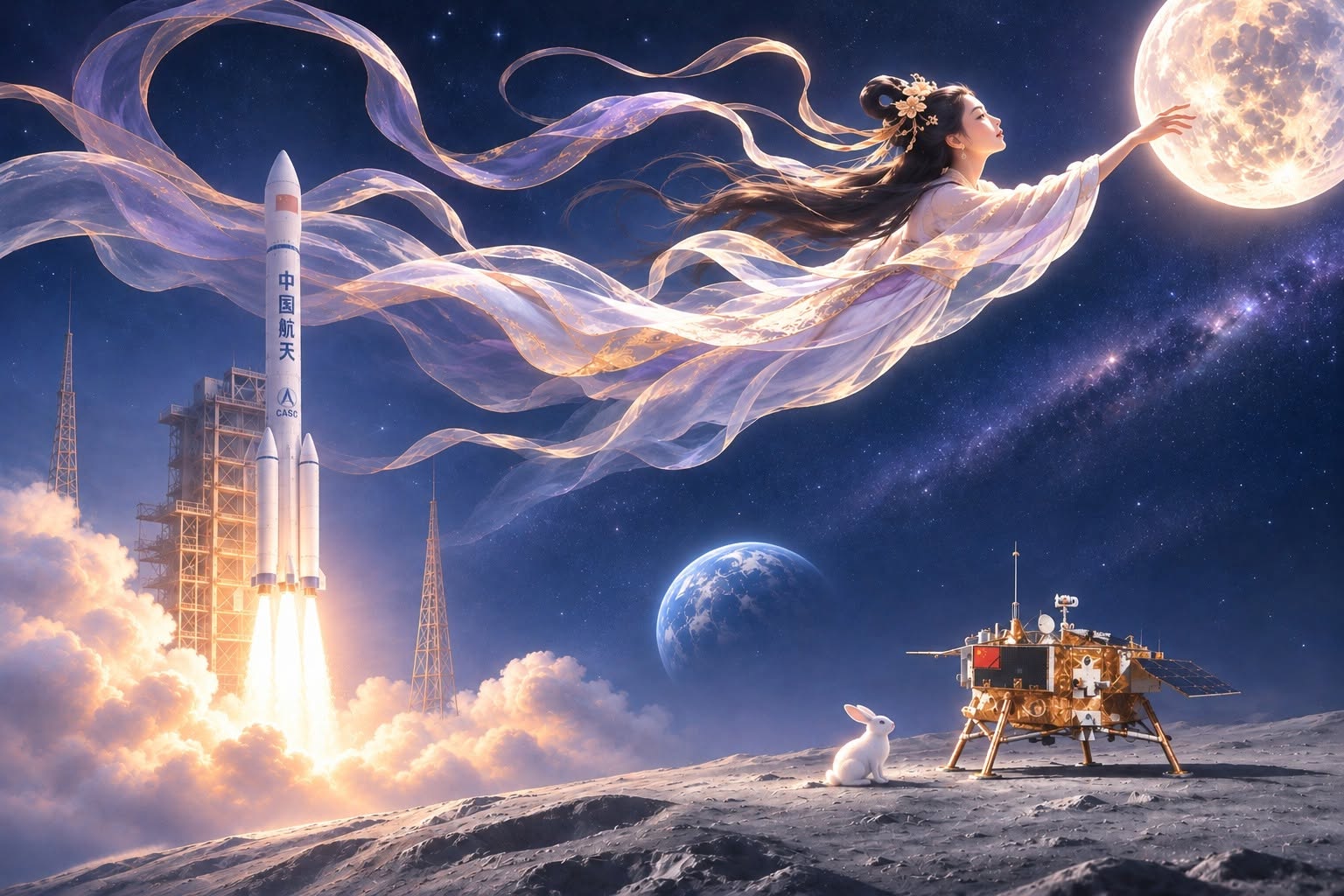
China's lunar exploration program is called 嫦娥 (Cháng'é).
The name belongs to the legendary woman who drank an elixir of immortality and flew to the Moon.
Her companion in Chinese mythology is the Jade Rabbit, 玉兔 (Yùtù).
Naturally, when China sent rovers to explore the lunar surface, they were named Yutu and Yutu-2.
A spacecraft named after a Moon goddess.
A rover named after her rabbit.
And when engineers needed a communications satellite to reach the far side of the Moon, they turned to another ancient story.
In Chinese mythology, the Cowherd and Weaver Girl are lovers separated by the Milky Way.
Once a year, magpies form a bridge across the heavens to reunite them.
That bridge is 鵲橋 (Quèqiáo).
Today, Queqiao is the name of China's lunar communications relay satellites.
Their task is to bridge the communication gap between Earth and the far side of the Moon.
A mythical bridge connecting lovers became a technological bridge connecting worlds.
Could there be a more beautiful name for a communications satellite?
A poem becomes a lunar lander
China is also developing a spacecraft designed to land astronauts on the Moon.
Its name is 攬月 (Lǎnyuè).
Literally, "Grasping the Moon."
The words come from a line written by Mao Zedong in 1965:
可上九天攬月
"We can ascend to the highest heavens and grasp the Moon."
From Shuidiao Getou: Revisiting Jinggangshan (水調歌頭·重上井岡山).
What was once an expression of human ambition has become the name of an actual lunar lander.
And perhaps that is the remarkable thing.
The technology has changed beyond recognition.
But the language of ambition has remained poetry.
A ship from the Divine Land to the Heavenly Palace
China's crewed spacecraft are called 神舟 (Shénzhōu).
It is a subtle play on words.
China has long been poetically called 神州 (Shénzhōu), the Divine Land.
Replace just one character:
神州: Divine Land
神舟: Divine Vessel
Same pronunciation.
A different meaning.
The Divine Land becomes a Divine Vessel.
And where does this vessel take its astronauts?
To 天宮 (Tiāngōng), the Heavenly Palace.
In Chinese mythology and literature, 天宮 is the celestial residence of gods and immortals.
In Journey to the West (西遊記), Sun Wukong famously turns the palace upside down.
Today, Tiangong is China's space station.
Astronauts live there, conduct experiments, and watch the Earth from orbit.
The Divine Vessel carries human beings to the Heavenly Palace.
That is not a line from an ancient fantasy novel.
It is a description of China's modern space program.
Asking the heavens
China's planetary exploration program carries an equally extraordinary name.
天問 (Tiānwèn).
"Questions to Heaven."
The name comes from a famous poem in the Chu Ci (楚辭), traditionally attributed to Qu Yuan (屈原), more than two thousand years ago.
It begins by questioning the origins of the universe:
遂古之初,誰傳道之?
"Who told the story of the beginning of antiquity?"
上下未形,何由考之?
"Before heaven and earth took shape, how could anyone know?"
In 2020, China launched 天問一號 (Tianwen-1) toward Mars.
The mission reached Mars in 2021, successfully placing a rover on its surface.
More than two thousand years after those questions were written, a spacecraft bearing their name traveled to another planet.
The methods are different.
But the questions have never stopped.
Before the first stars
And perhaps the most poetic name is still ahead.
China's planned 鴻蒙 (Hóngméng) satellite constellation is intended to study the universe through low-frequency radio astronomy, using the Moon's far side as a shield against Earth's radio interference.
The name comes from ancient Chinese thought.
鴻蒙 evokes the primordial chaos before the cosmos took shape.
It also appears in the Daoist classic Zhuangzi (莊子).
The project's scientific ambitions include exploring the cosmic Dark Ages, the era before the first stars began to shine.
Consider the extraordinary connection.
Ancient philosophers imagined a mysterious state before the world took form.
Modern scientists are designing instruments to investigate the universe before its first light.
An ancient word for primordial chaos becomes the name of a mission searching for the beginning of cosmic history.
The technology is modern. The imagination is ancient.
What makes these names so remarkable is not simply that they sound beautiful.
It is how precisely the poetry fits the technology.
嫦娥, the woman who flew to the Moon, becomes a lunar spacecraft.
玉兔, the Jade Rabbit, becomes a lunar rover.
鵲橋, the bridge across the heavens, becomes a communications relay.
攬月, grasping the Moon, becomes a crewed lunar lander.
神舟, the Divine Vessel, carries astronauts to 天宮, the Heavenly Palace.
天問, Questions to Heaven, becomes a planetary exploration program.
And 鴻蒙, primordial chaos, becomes a project to investigate the universe before the first stars.
These are not arbitrary names attached to machines.
They are ancient images finding astonishingly appropriate places in modern engineering.
Perhaps one might expect advanced technology to replace mythology and poetry with something more practical.
But here, the opposite seems to have happened.
The more ambitious the technology becomes, the more meaningful the ancient words become.
China's spacecraft travel with computers, engines, sensors, and antennas.
Yet their names carry something no machine could invent.
Thousands of years of imagination.
Science has given humanity the power to reach the heavens. Poetry has ensured that we never forget why we wanted to go there.